
Theses on the construction of one's own self-theory. Published by Californian post-situationist group For Ourselves in February 1974.

Libcom preamble
The text below and attached PDF are the original version published in 1974, complete with original graphics and emphases. There is a completely rewritten version of the text at The Anarchist Library, which claims to be taken from the Lust For Life site.
However a quick look at that site reveals the original (not rewritten) text and an introduction criticising the various uncredited reworkings of the original. Some of these are available on Libcom:
- Revolutionary self-theory: A beginners' manual - Larry Law (1985)
- The revolutionary pleasure of thinking for yourself - anonymous (nd: 1990s/2000s?)
It is deeply ironic that the author of the Lust For Life site focuses his ire on the lack of credit for the original authors and some spelling mistakes in the reworked versions, rather than explicitly critiquing the content and differences in the new texts. You would think that if readers of the original text heeded its call, that they may very well develop their own radical subjectivity and self-theory by reworking the text in many different ways. Rather than adopting a fundamentalist approach to authorial authority, the task should be for revolutionaries to engage in open criticism and discussion. Or to put it another way:
The process of demystifying yourself, as the process of social revolution, is a game (the individual and collective insistence upon playfulness, upon pleasure) or it is nothing (the individual and collective acceptance of alienation, of ideology and morality). A cardinal object of the game is to stay off of Flatland, with its twin swamps of lost thought--absolutism and antitheticality--that camouflage themselves as meadows of subjectivity.
Absolutism is the total acceptance or total rejection of all components of ideologles, spectacles, and reifications. An absolutist cannot see any other choice than complete acceptance or complete rejection.
Finally, it is worth noting that the Lust For Life site's list of contents commences with several documents about the Rothschilds and includes nonsense such as "COVID-1984 as the Great [Rothschildian] Reset", alongside a typically wearying roll call of enduring conspiracy theory topics.
Introduction
This booklet is for people who are dissatisfied with their lives. If you are happy with your present existence, we have no argument with you. However, if you are tired of waiting for your life to change...
Tired of waiting for authentic community, love and adventure... Tired of waiting for the end of money and forced work... Tired of looking for new pastimes to pass the time... Tired of waiting for a lush, rich existence... Tired of waiting for a situation in which you can realise all your desires... Tired of waiting for the end of all authorities, alienations, ideologies and moralities... ...then we think you’ll find what follows to be quite handy.
I
One of the great secrets of our miserable yet potentially marvellous time is that thinking can be a pleasure. This is a manual for constructing your own self-theory. Constructing your self-theory is a revolutionary pleasure, the pleasure of constructing your self-theory of revolution.
Building your self-theory is a destructive/constructive pleasure, because you are building a theory-of-practice for the destructive/constructive transformation of this society.
Self-theory is a theory of adventure. It is as erotic and humorous as an authentic revolution.
The alienation felt as a result of having had your thinking done for you by the ideologies of our day, can lead to the search for the pleasurable negation of that alienation: thinking for yourself. It is the pleasure of making your mind your own.
Self-theory is the body of critical thought you construct for your own use. You construct it and use it when you make an analysis of why your life is the way it is, why the world is the way it is. (And ‘thinking’ and ‘feeling’ are inseparable, since thought comes from subjective, emotive experience.) You build your self-theory when you develop a theory of practice — a theory of how to get what you desire for your life.
Theory will be either a practical theory — a theory of revolutionary practice — or it will be nothing... nothing but an aquarium of ideas, a contemplative interpretation of the world. The realm of ideals is the eternal waiting-room of unrealised desire.
Those who assume (usually unconsciously) the impossibility of realising their life’s desires, and of thus fighting for themselves (their "selfs", usually end up fighting for an ideal or cause instead (i.e., the illusion of self-activity or self-practice). Those who know that this is the acceptance of alienation will now know that all ideals and causes are ideologies.
II
Whenever a system of ideas is structured with an abstraction at the centre — assigning a role or duties to you for its sake — this system is an ideology. An ideology is a system of false consciousness in which you no longer function as the subject in your relation to the world.
The various forms of ideology are all structured around different abstractions, yet they all serve the interests of a dominant (or aspiring dominant) class by giving you a sense of purpose in your sacrifice, suffering and submission.
Religious ideology is the oldest example, the fantastic projection called ‘God’ is the Supreme Subject of the cosmos, acting on every human being as ‘His’ subject.
In the ‘scientific’ and ‘democratic’ ideologies of bourgeois enterprise, capital investment is the ‘productive’ subject directing world history — the ‘invisible hand’ guiding human development. The bourgeoisie had to attack and weaken the power that religious ideology once held. It exposed the mystification of the religious world in its technological investigation, expanding the realm of things and methods out of which it could make a profit.
The various brands of Leninism are ‘revolutionary’ ideologies in which their Party is the rightful subject to dictate world history, by leading its object — the proletariat — to the goal of replacing the bourgeois apparatus with a Leninist one.
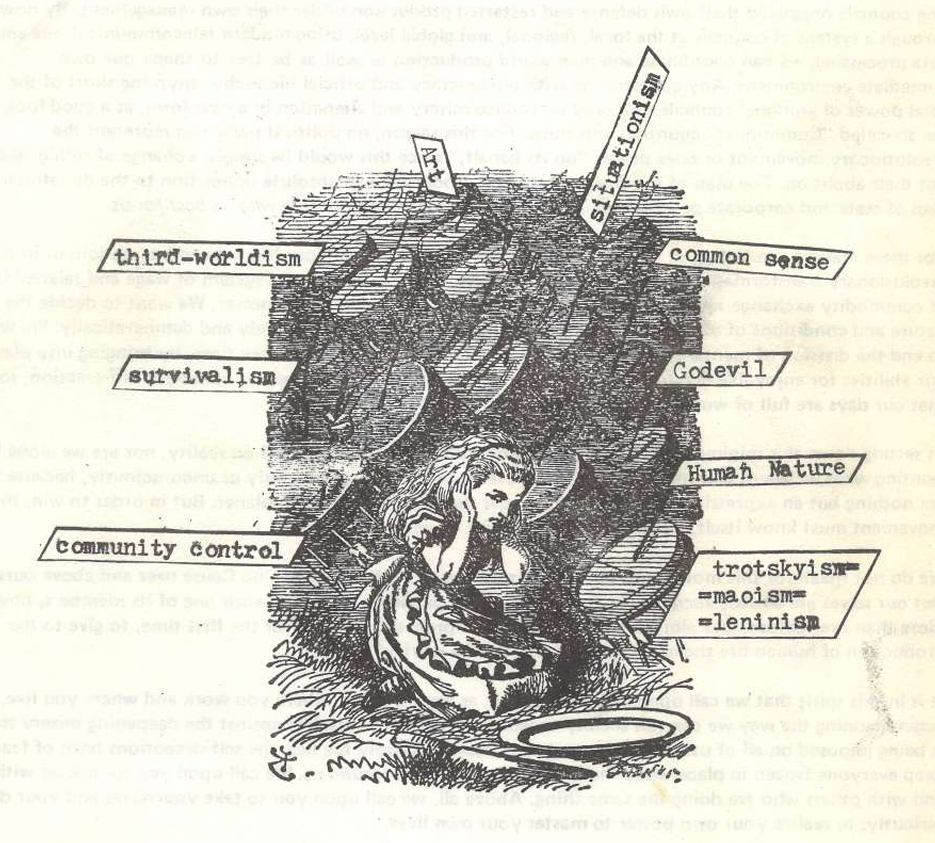
The many other forms of the dominant ideologies can be seen daily. The rise of the new religiomsyticisms serve the dominant structure of social relations in a round about way. They provide a neat form in which the emptiness of daily life may be obscured, and like drugs, make it easier to live with. Volunteerism (shoulder to the wheel) and determinism (it’ll all work out) prevent us from recognising our real place in the functioning of the world. In avant-garde ideology, novelty in (and of) itself is what’s important. In survivalism, subjectivity is preempted by fear through the invocation of the image of an impending world catastrophe.
In accepting ideologies we accept an inversion of subject and object; things take on a human power and will, while human beings have their place as things. Ideology is upside-down theory. We further accept the separation between the narrow reality of our daily life, and the image of a world totality that’s out of our grasp. Ideology offers us only a voyeur’s relationship with the totality.
In this separation, and this acceptance of sacrifice for the cause, every ideology serves to protect the dominant social order. Authorities whose power depends on separation must deny us our subjectivity in order to survive themselves. Such denial comes in the form of demanding sacrifices for ‘the common good’, ‘the national interest’, ‘the war effort’, ‘the revolution’....
III
We get rid of the blinders of ideology by constantly asking ourselves... How do I feel?
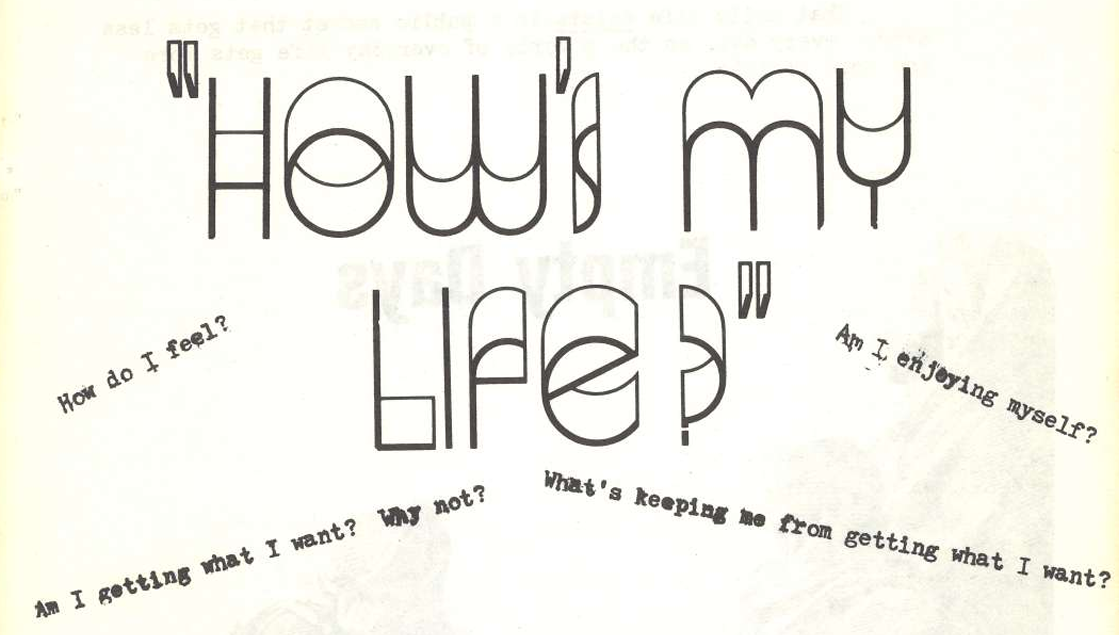
This is having consciousness of the commonplace, awareness of one’s everyday routine.
That Everyday Life — real life — exists, is a public secret that gets less secret every day, as the poverty of daily life gets more and more visible.
IV
The construction of your self-theory is based on thinking for yourself, being fully conscious of your desires and their validity. We call this positive self-conscious egoism1 , or radical subjectivity.
Authentic "consciousness raising" can only be the "raising’"of people’s thinking to the "level" of positive (non-guilty) self-consciousness: developing their radical subjectivity, free of ideology and morality in all its forms.
The essence of what many leftists, therapy-mongers, and sisterizers term "consciousness raising" is their practice of beating people into unconsciousness with their ideological billyclubs.
The path from ideology (self-negation) to radical subjectivity (self-affirmation) passes through Point Zero, the capital city of nihilism. This is the windswept still point in social space and time... the social limbo wherein which one recognises that the present is devoid of life; that there is no life in one’s daily existence. A nihilist knows the difference between surviving and living.
The nihilist goes through a reversal or perspective on his life and the world. Nothing is true for him but his desires, his will to live. He refuses all ideology in his hatred for the miserable social relations in modern capitalist-global society. From this reversed perspective he sees with a newly acquired clarity the upside-down world of reification, the "thingification" of daily life, the inversion of subject and object, of abstract and concrete. It is the theatrical landscape of fetishised commodities, mental projections, separations and ideologies: art, God, city planning, ethics, commons sense2 , ethics, smile buttons, radio stations that say they love you and detergents that have compassion for your hands.3
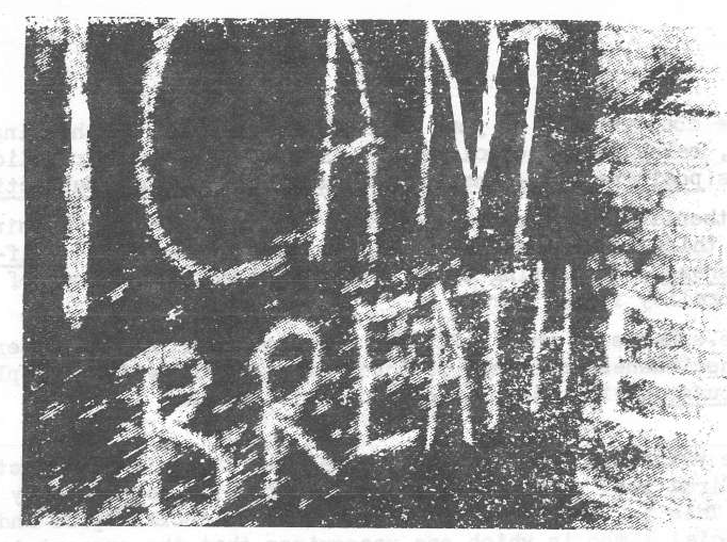
The nihilist constantly feels the urge to destroy the system which destroys him each day. He cannot go on living as he is, hismind is on fire. Soon enough he runs up against the fact that he must come up with a coherent set of tactics that will have a practical effect on the world.
But if a nihilist does not know of the historical possibility for the transformation of the world, his or her subjective rage will coralise into a role: the suicide, the solitary murderer, the street hoodlum vandal, the neo-dadaist, the professional mental patient... all seeking compensation for a life of dead time.
The nihilist's mistake is that he does not realise that there are others who are also nihilists. He assumes that common communication and participation in a project of self-realization is impossible.
V
To have a "political" orientation towards one’s life is just to know that you can only change your life by changing the nature of life itself through transformation of the world — and that transformation of the world requires collective effort.
Politics, defined as the area of human activity dealing with forms of social organization, is a mystified artificial category. But politics as such is not just a semantic error — it is socially enforced, along with all the other socially-enforced separations of human activity: work and play, art and everyday life, imagination and reality. The separation of "politics" is the social falsification of collective realization.
Collective self-realisation is the revolutionary project. It is the collective seizure of the totality of nature and social relations and their transformation according to conscious desire.
Authentic therapy is changing one’s life by changing the nature of social life. Therapy must be social if it is to be consequential. Social therapy (the healing of society) and individual therapy (the healing of the individual) have a dialectical relationship: each requires the other, each is a necessary part of the other. For example: the dissolution of individuals' character-armor (the build up of a callus of role-playing, posing, and concealing desire as a defence against the wear and tear of daily life) is dialectically related to the termination of the social spectacle of Role.
VI
To think subjectively is to use your life — as it is now and as you want it to be — as the centre of your thinking. This positive self-centring is accomplished by the continuous assault on externals: all the (1) false issues, (2) false conflicts, (3) false problems, (4) false identities and (5) false dichotomies.
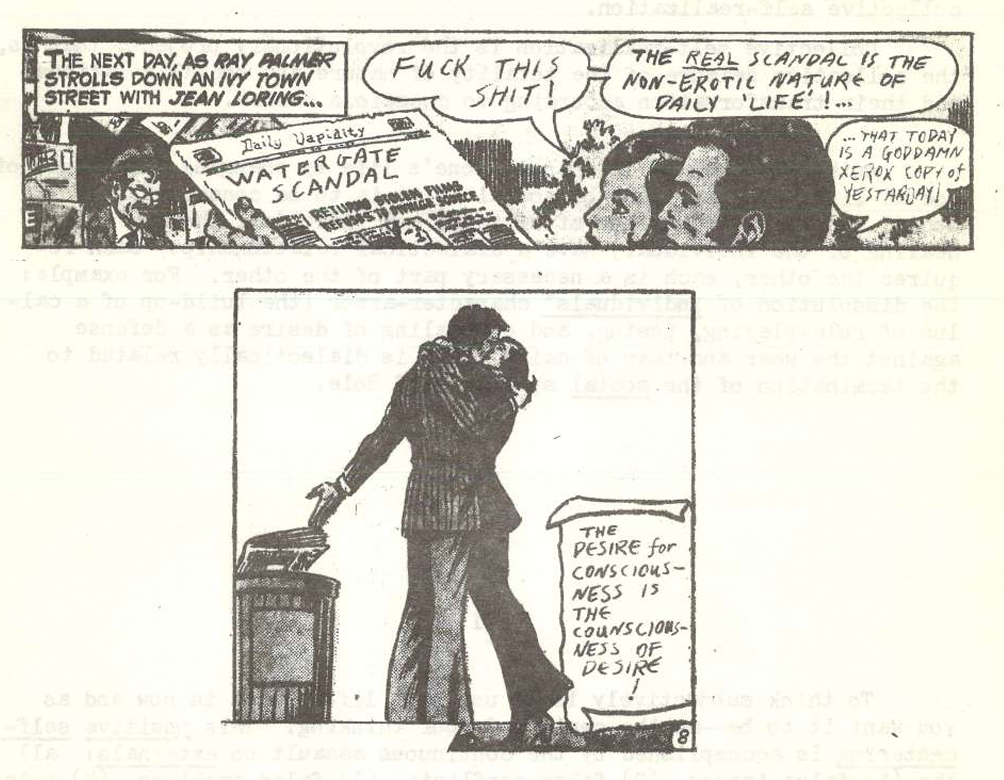
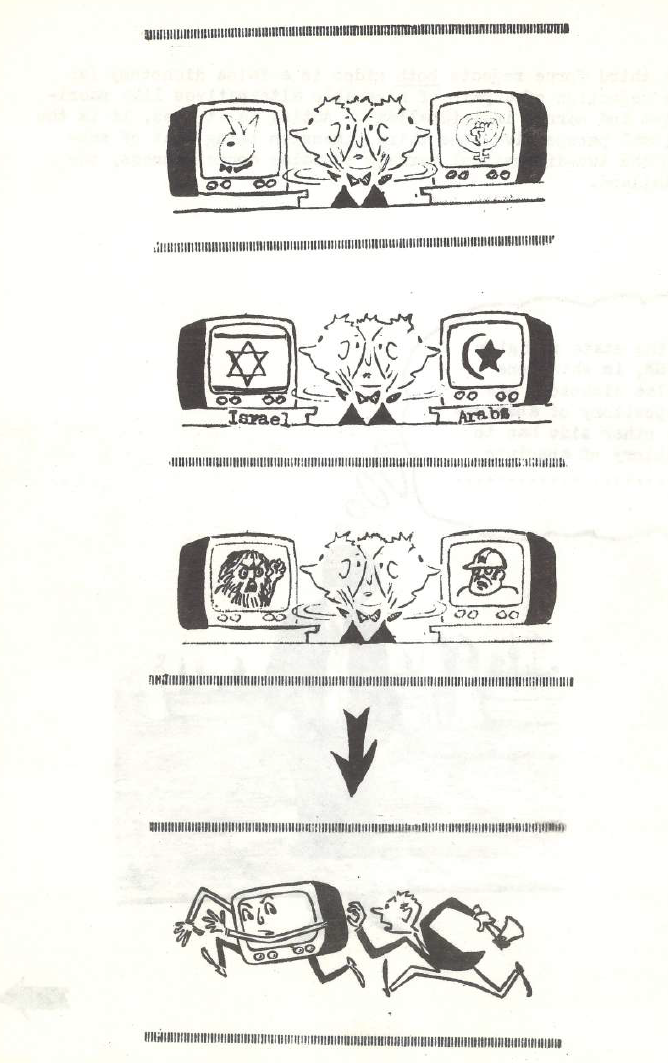
(1) People are kept from analysing the totality of everyday existence by being asked their opinion of every detail: all the spectacular trifles, phoney controversies and false scandals. Are you for or against militant kidnappers, vegetarianism, impeaching Nixon... what’s your opinion of neo-decadence? rapid transit? UFO's? the Middle East?
All these are false issues. The only "issue" for us is how we live. (See the introduction)
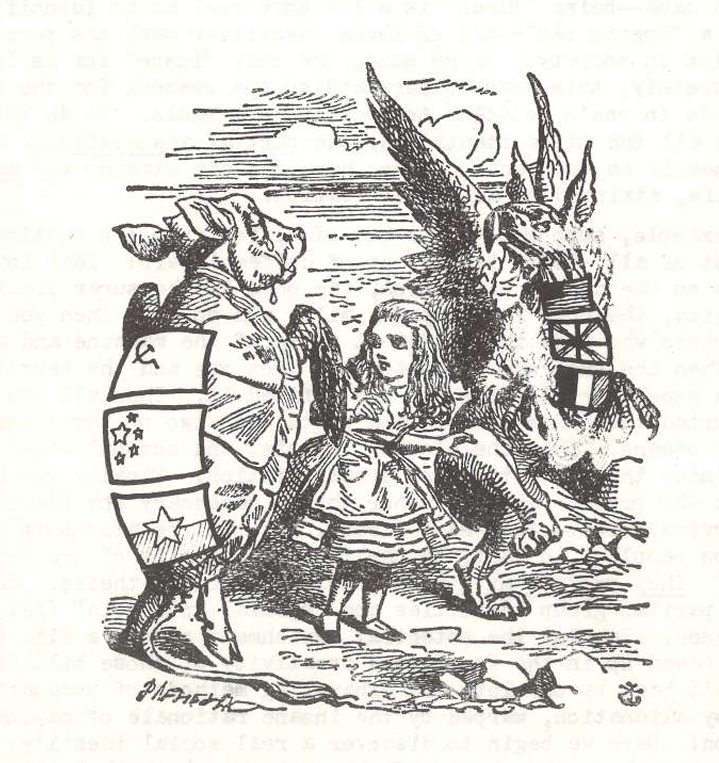
(2) The force that can give lie to both sides of a false conflict is what we call the third force: the force of radical subjectivity, and in particular, a qualitative, non-dualistic perspective.
Being conscious of the third choice is refusing to choose between two supposedly opposite but really equal polarities that try to define themselves as the totality of a situation. In its simplest form, this consciousness is expressed by the worker who is brought to trial for armed robbery and asked, “Do you plead guilty or not guilty?”. “I’m unemployed”, he says. A more theoretical but equally classic illustration is the refusal to acknowledge any essential difference between the corporate-capitalist ruling classes of the "West" and the state-capitalist ruling classes of the "East". From the point of view of the third force, all we have to do is look at the basic social relations of production in the USA and Europe on the one hand, and the USSR and China on the other, to see that they are essentially the same: over there, as here, the vast majority go to work for a wage or salary in exchange for giving up control over both the means of production and what they produce (which is then sold back to them in the form of commodities).
In the case of the "West" the surplus value (i.e., that which is produced over and above the value of the workers’ wages) is the property of the corporate managements who keep up a show of domestic competition. In the ‘East’ the surplus value is the property of the state bureaucracy, which does not permit domestic competition but engages in international competition as furiously as any other capitalist nation. Big difference.
(3) An example of a false problem is that stupid cocktail-party question, “What’s your philosophy of life?”. It poses an eternal, abstract concept of "Life" that, despite its semantic appearance, has nothing to do with daily life, because it is present-less
(4) In the absence of real community, people cling to all kinds of phony social identities, corresponding to their individual role in the Spectacle (in which people contemplate and consume images of what life is, so that they will forget how to live for themselves). These social identities can be ethnic (‘Italian’), racial (‘Black’), organisational (‘Trade Unionist’), residential (‘New Yorker’), sexual (‘Gay’), cultural (‘sports fan’), and so on: but all are rooted in a common desire for affiliation, for belonging.
Beyond a certain point, different in each case - being "Black" is a lot more real as an identification than being a "sports fan" - all of these identities mask the person's real position in society. As we said, the only "issue" for us is how we live. Concretely, this means understanding the reasons for the nature of one's life in one's relation to society as a whole. To do this, one has to shed all false identities, the partial associations, and begin with oneself as the center. From here one can examine the material basis of life, stripped of all mystification.
For example: suppose I want a cup of coffee from the machine at work. First of all, there is the cup of coffee itself: that involves the workers on the coffee plantation, the ones on the sugar plantations and in the refineries, the ones in the paper mill, and so on. Then you have all the workers who made the different parts of the machine and assembled it. Then the ones who extracted the iron ore and bauxite, smelted the steel, drilled the oil and refined it. Then all the workers who transported the raw materials and parts over three continents and two oceans. Then the clerks, typists and communications workers who co-ordinate the production and transportation. Finally you have all the workers who produce all the other things necessary for the others to survive. That gives me a direct material relationship to several million people: in fact, to the immense majority of the world’s population. They produce my life: I help to produce theirs. In this light, all partial group identities and special interests fade into insignificance. Imagine the potential enrichment of one’s life that is presently locked up in the frustrated creativity of those millions of workers, held back by obsolete and exhausting methods of production, strangled by alienation, warped by the insane rationale of capital accumulation! Here we begin to discover a real social identity: in people all over the world who are fighting to win back their lives, we find ourselves.
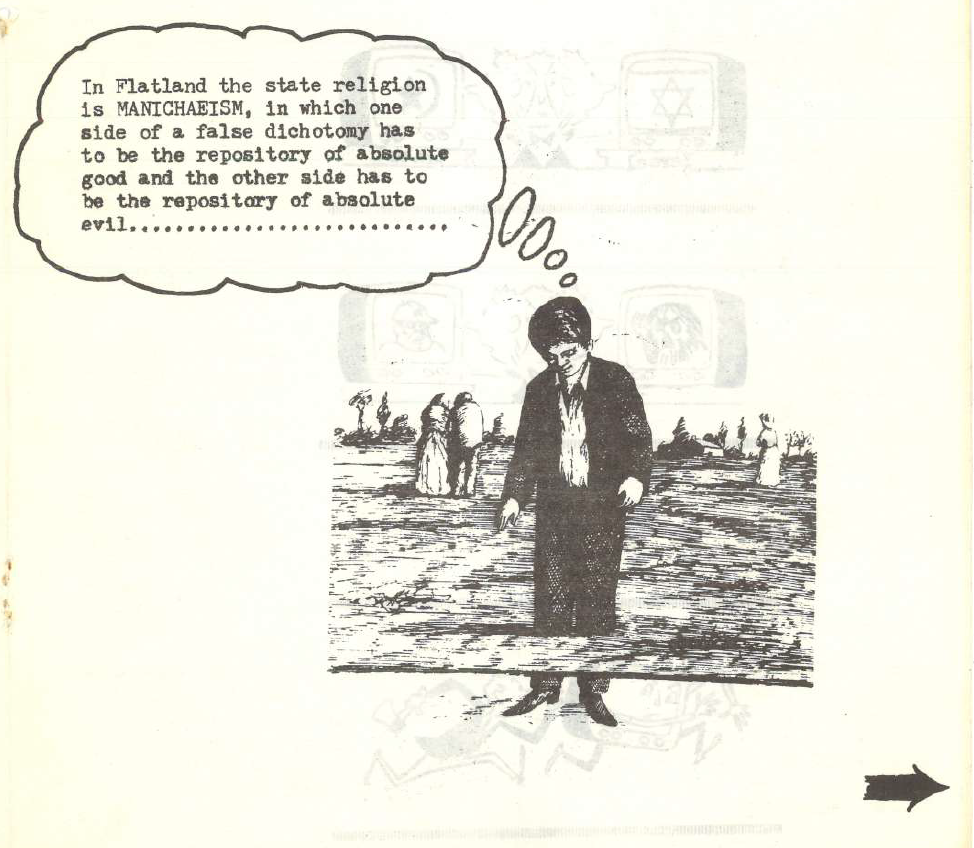
(5) The third force rejects both sides in a false dichotomy (an example: the rejection of a pair of miserable alternatives like sacrificial altruism and narrow individualism). Acting as it does, it is the three-dimensional perspective - the third dimension being that of subjectivity - on the two dimenstional terrain of false consciousness, the terrain of Flatland.
VII
The process of demystifying yourself, as the process of social revolution, is a game (the individual and collective insistence upon playfulness, upon pleasure) or it is nothing (the individual and collective acceptance of alienation, of ideology and morality). A cardinal object of the game is to stay off of Flatland, with its twin swamps of lost thought--absolutism and antitheticality--that camouflage themselves as meadows of subjectivity.
Absolutism is the total acceptance or total rejection of all components of ideologles, spectacles, and reifications. An absolutist cannot see any other choice than complete acceptance or complete rejection.
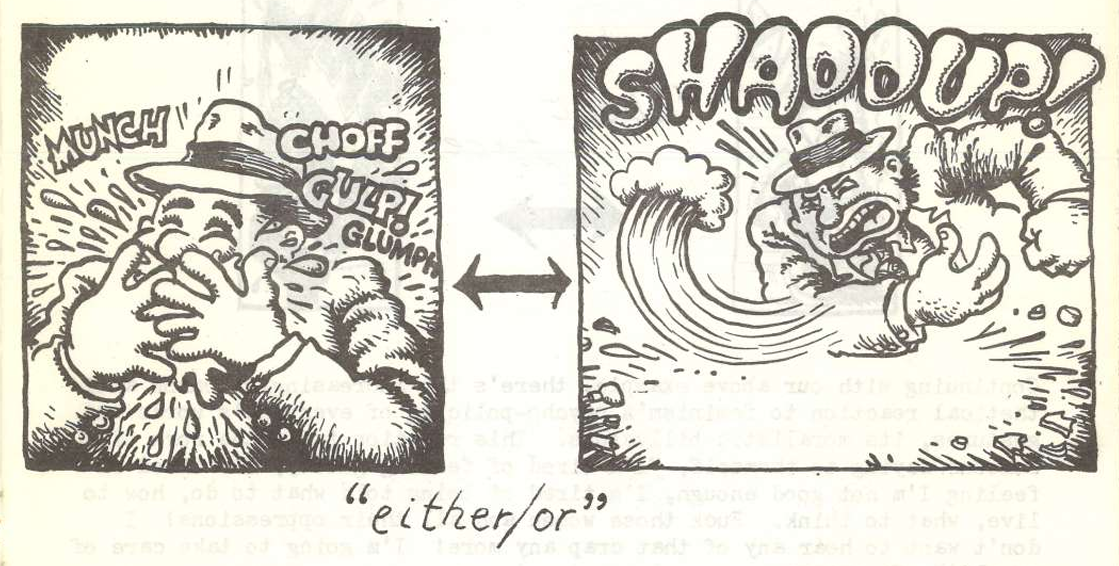
Whereas a dialectician critically appropriates the authenticities, the "rational kernel", from the ideologies and spectacles of our time, an absolutist categorically seizes or dismisses that which is paraded before him or her.
A common example is feminism. The dialectician critically appropriates its critique of the world of male domination while rejecting its (unconscious) manichaean deduction that since women are miserable, men must be enjoying their iives. This three-dimensional thought process is invisible to the absolutist, trapped in his or her two-dimensional world, All he or she can do is either completely accept feminism or reject it as beirg "total ideclogy" or "just another spectacle". And as with feminism, so with the ecology spectacle, yoga, natural food fetishism, Art, etc.
Antithetical thinking and activity is the Flatlandish reaction to life dominated by ideology and morality. The reaction is of an oppositetherefore- equal nature, as the flip side of shit is still shit.
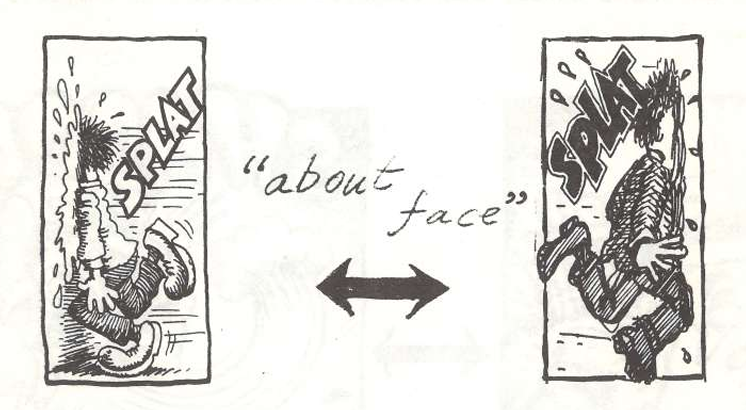
Continuing with our above example, there's the increasingly-common antithetical reaction to feminism's psycho-policing of everyone's words and gestures, its moralistic billyclubs. This reaction takes the form of someone saying to themself, "I'm tired of feeling guilty, I'm tired of feeling I'm not good enough, I'm tired of being told what to do, how to live, what to think, Fuck those women and all their oppressions! I don't want to hear any of that crap any more! I'm going to take care of myself!" Et cetera...
Antithetical thinking appears subjective, but it's still defining oneself in the terms of the ideology. It is an abstract negation of ideology, whereas a dialectical critique is a concrete, determinate negation, A determinate negation is one that appropriates the partial truth of the ideology and the partial truth of its antithesis, and combines them in a synthesis that goes above and beyond either or both of-them. Free, unbounded thinking-for-oneself can only be dialectical., Dialectics lost is subjectivity lost.
VIII
The process of dialectical thinking is synthetic thinking, a process of continually synthesizing one's current body of self-theory with new theoretical observations and appropriations; a resolution of the contradictions between the previous body of theory and new theoretical elements., The resulting synthesis is thus not some quantitative summation of the previous and the new, but their qualitative supersession, a new totality.
The synthetic/dialectical method of construction of theory is counter to the eclectic style. Eclecticism is the absence of the synthesis. Conflicting elements slide over each other, pass each other by, without confronting their contradictions. What appears to be a synthesis is essentially just a collodial suspension, and usually an ideological one: anarcho-Maoism, libertarian capitalism, hippie leninism,
If one is continually conscious of how one wants to live, one can critically appropriate from anything in the synthesis of one's selftheory: ideologies, culture critics, technocratic experts, sociological studies, mystics, and so forth, All the rubbish of the old world can be scavanged for useful material by those who desire to reconstruct it.
IX
The nature of modern society, its global and capitalist unity, indicates to us the necessity of one's self-theory to be a unitary eritique. By this we mean a critique of all geographic areas where various forms of socio-economic domination exist (for example, capitalism American-Style and state-capitalism China-Russia-Style), as well as a critique of all alienations (sexual poverty, enforced survival, urbanism, etc),. In other words, a critique of the totality of daily existence everywhere, from the perspective of the totality of one's desires.
As we see it, a unitary critique is vital due to the existence of an invisible (even to itself) "United Front Against Subjectivity": all the politicians and bureaucrats, preachers and gurus, city planners and policemen, reformists and militants, Central Committees and anarcho-moralists, corporate managers and union leaders, male supremacists and feminist ideologues, psycho-sociologists and. recyclo-ecologists who work to subordinate individual desire to a reified "common good" that has supposedly “designated them" as its represeniatives, They are all forces of the old world, all bosses, priests, and creeps who have something
to lose if people extend the game of seizing back their minds into seizing back their lives.
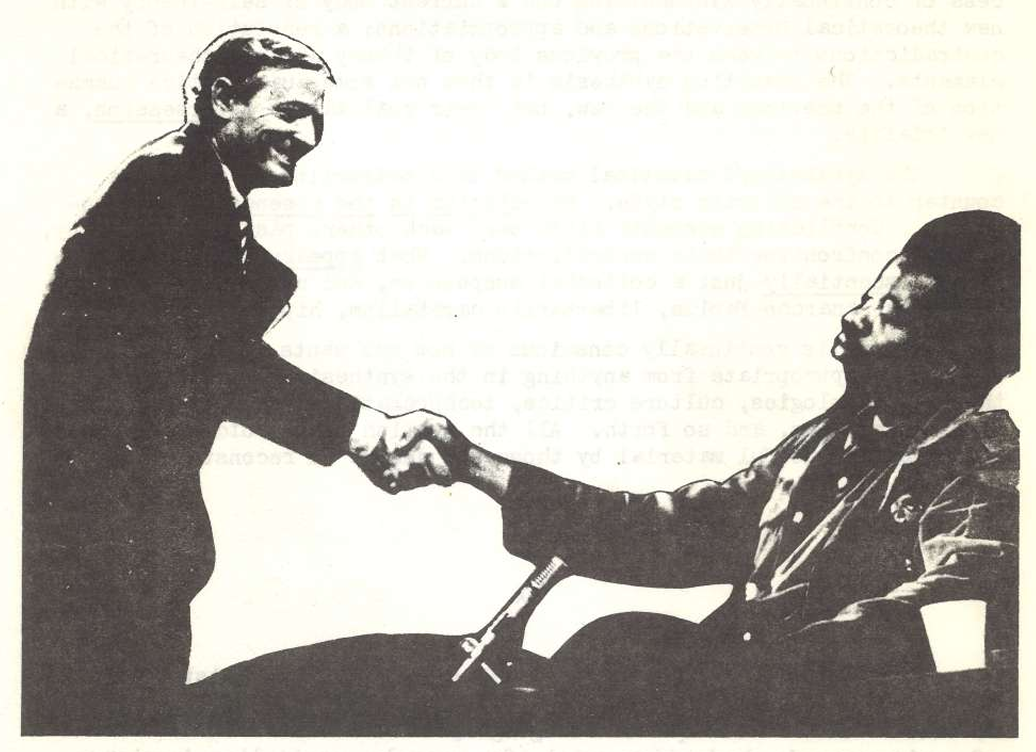
Revolutionary theory and revolutionary ideology are enemies — and both know it.
X
By now it should be obvious that self-demystification and construction of one's self-theory doesn't eradicate one's alienation: "the world" (capital and the Spectacle) goes on, reproducing itself each day.
Although this booklet has the construction of self-theory as its focus, we never intend to imply that revolutionary theory can exist separate from revolutionary practice. The problem of "How to close the gap between theory and practice" that has riddled the skulls of leftist ideologists is resolved by the recognition of the dialectic of theory and practice: one's theory is a theory of practice, and one's practice is a practice of theory, One continually draws the theory out of one s practice and the practice out of one's theory. The revolutionary project requires a theoretical practice and a practical theory. In order to be consequential, to effectively reconstruct the world, practice must seek its theory, and theory must "see" its practice.
The above paragraph is not a set of abstract scphis‘ms, but our recognition of the concrete fact that the revolutienary project of di:.aalienation and the transformation of social relations requires that one's theory be nothing other than a theory of practice, of what one does. Otherwise theory will degenerate intc an impotent c?ntemplation of the world, and ultimately into survival ideology--a projected mental fogbank, a static (undialectical) body of reified thought, of intellectual armor, that actsas buffer between the daily world and oneself, And if revolutionary practice is not the practice of revolutionary theory (the struggle for self-realization, for the realization of one's conscious desires), it degenerates into altruistic militantism, "revolutionary" activity as one's social duty.
When we are simultaneously and conéciously the subject and the object of our thought and all our activity, the concrete unity of theory and practice exists.
The strength of one's theory--and the relationship of one's theory to one's practice--lies in its coherence, its internal logical arrangement, Tn a coherent theory, the various specific critiques of particular alienations, ideologies, and historical moments of revolutionary activity are consciously and visibly connected to form a unified, orderly whole. An effort is made to have the components of the theory be reflected in each other. In other words, everything hangs together.
We don't strive for coherence as an end-in-itself, or only for any esthetic value it might have., For us, the value of coherence is its practical use-value. Having a coherent self-theory makes it easier for someone to think, As an example, it's easier to get a handle on future developments in social control if you have a coherent understanding of modern social control ideologies and techniques up to the present.
Having a coherent theory makes it easier to conceive of the theoretical practice for realizing your desires for your life.
XI
In the process of constructing self-theory, the last ideologies that have to be wrestled with and determinately pinned down are the ones that most closely resemble revolutionary theory. On the American terrain, these fimal mystifications are (1) situationism, and (2) councilism.
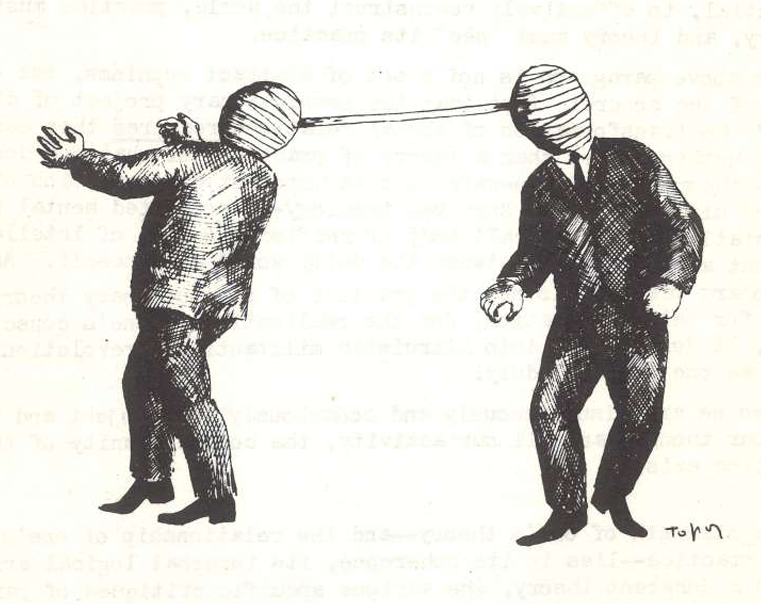
(1) The Situationist International (1958-1971) was an international revolutionary organization that made an immense contribution to revolutionary theory. Situationist theory is a body of critical theory that can be appropriated into one's self-theory, and nothing more. Anything "more” is the ideological misappropriation known as situationism.
For those who newly discover it, S.I. theory has a way of seeming like "the answer I've searched for for years," the answer to the riddle of one's dead life, But that's exactly when a new alertness and selfrepossession become necessary, Situationism can be quite the complete survival ideology, a defense-mechanism against the wear and tear of daily life., Included in the ideology is the spectacular commodity-role of being "a Situationist", i.e., a radical jade and ardent esoteric.
(2) Self-management is the direct management (unmediated by any separate leadership) of social production, distribution, and communication by the workers and their communities. The movement for selfmanagement has appeared again and again all over the world in the course of social revolution in this century: Russia in 1905 and 1917-1921, Spain in 1936-1937, Hungary in 1956, Algeria in 1960, and embryonically in Chile in 1972, The form of organization most often created in the practice of self-management has been workers' councils: soverign general assemblies of the producers and neighborhoods that elect mandated delegates to coordinate their activities, The delegates are not representatives, but carry out decisions already made by their assemblies, Delegates can be recalled at any time, should the general assembly feel that its decisions are not being rigorously carried out.
Councilism is the ideological inversion of the historical gractice and theory of the Workers' Councils and of the May-June 1968 Occupation Movement in France. Whereas the participants in these uprisings lived a critique of the social totality, beginning with a critique of wage-labor, of the commodity-economy and exchange-value, councilism makes partial critique: it seeks not the self-managed continuous and qualitative transformation of the whole world, but the static, quantitative "self-management” of the world as it is.4 And in that, its view of self-management is that of the democratic associated management of the old world's production-distribution-repair sector only.5 Whereas the movement for generalized self-management seeks the transformation of all sectors of social life and all social relations (production, sexuality, housing, services, communication, etc.), councilism thinks that a self-managed economy is all that matters. It misses, literally, the whole point: subjectivity and the desire to transform the whole of life.
Because of their lack of subjectivity, the councilists end up fighting for a cause. A councilist becomes a partisan of Workers' Councils, nothing more, He cannot fight for himself because he has not yet found his self,
Afterword
This booklet is part of the collective self-theory of the members of our organization. It is the statement of what we call our meta-theory, our theory of the practice of theory-making.
The preparation and dissemination of The Minimum Definition of Intelligence is undertaken for the same reason we do everything else we do: because we want to catalyze a social revolution that will transform the present static layout of alienation into a moving landscape of realized dreams. We know we can only create the lives that we want in the process of everyone else creating the lives that they want. We are revolutionaries because our desires require a social revolution for their realization.
The world can only be turned right-side-up by the conscious collective activity of those who construct a theory of why it is upside-down. Spontaneous rebellion and insurrectionary subjectivity alone are not sufficient. An authentic revolution can only occur in a practical movement in which all the mystifications of the past are consciously being swept away.
Preamble: For Ourselves - Council For Generalized Self-Management
We have woken up to discover that our lives are becoming unliveable. From boring, meaningless jobs to the humiliation of waiting endlessly in lines, at desks and counters to receive our share of survival, from prison-like schools to repetitious, mindless “entertainment,” from desolate and crime-ridden streets to the stifling isolation of home, our days are a treadmill on which we run faster and faster just to keep in the same place.
Like the immense majority of the population, we have no control over the use to which our lives are put: we are people who have nothing to sell but our capacity to work. We have come together because we can no longer tolerate the way we are forced to exist, we can no longer tolerate being squeezed dry of our energies, being used up and thrown away, only to create a world that grows more alien and ugly every day.
The system of Capital, whether in its “Western” private-corporate or “Eastern” state-bureaucratic form, was brutal and exploitative even during its ascent: now, where it is in decay, it poisons air and water, produces goods and services of deteriorating quality, and is less and less able to employ us even to its own advantage. Its logic of accumulation and competition leads inexorably toward its own collapse. Even as it links all the people of the world together in one vast network of production and consumption, it isolates us from each other; even as it stimulates greater and greater advances in technology and productive power, it finds itself incapable of putting them to use: even as it multiplies the possibilities for human self-realization, we find ourselves strangled in layers of guilt, fear and self-contempt.
But it is we ourselves — our strength, our intelligence, our creativity, our passions-that are the greatest productive power of all. It is we who produce and reproduce the world as it is, in the image of Capital; it is we who reinforce in each other the conditioning of family, school, church and media, the conditioning that keeps us slaves. When we decide together to end our misery, to take our lives into our own hands, we can recreate the world the way we want it. The technical resources and worldwide productive network developed under the old system give us the means: the crisis and continuing collapse of that system give us the chance and the urgent need.
The ruling ideologies of the world superpowers, with their interlocking sets of lies, offer us only the false choice of “Communism” versus “Capitalism”. But in the history of revolution during this century (Russia, 1905; Germany, 1919–20; Spain, 1936–37; Hungary, 1956) we have discovered the general form through which we can take back power over our own lives: workers’councils. At their highest moments these councils were popular assemblies in workplaces and communities, joined together by means of strictly mandated delegates who carried out decisions already made by their assemblies and who could be recalled by them at any time. The councils organized their nwn defense and restarted production under their own management. By now, through a system of councils at the local, regional, and global level, using modern telecommunications and data processing, we can coordinate and plan world production as well as be free to shape our own immediate environment. Any compromise with bureaucracy and official heirarchy, anything short of the total power of workers’ councils, can only reproduce misery and alienation in a new form, as a good look at the so-called “Communist” countries will show. For this reason, no political party can represent the revolutionary movement or seize power “on its behalf”, since this would be simply a change of ruling classes, not their abolition. The plan of the freely associated producers is in absolute opposition to the dictatorial Plan of state and corporate production. Only all of us together can decide what is best for us.
For these reasons, we call upon you and upon all the hundreds of millions like you and us, to join us in the revolutionary transformation of every aspect of life. We want to abolish the system of wage and salaried labor, of commodity exchange-value and of profit, of corporate and bureaucratic power. We want to decide the nature and conditions of everything we do, to manage all social life collectively and democratically. We want to end the division of mental from manual work and of “free” time from work time, by bringing into play all our abilities for enjoyable creative activity. We want the whole world to be our conscious self-creation, so that our days are full of wonder, learning, and pleasure. Nothing less.
In setting down this minimum program, we are not trying to impose an ideal on reality, nor are we alone in wanting what we want. Our ideas are already in everyone’s minds, consciously or unconsciously, because they are nothing but an expression of the real movement that exists all over the planet. But in order to win, this movement must know itself, its aims, and its enemies, as never before.
We do not speak for this movement, but for ourselves as of it. We recognize no Cause over and above ourselves. But our selves are already social: the whole human race produces the life of each one of its members, now more than ever before. Our aim is simply to make this process conscious for the first time, to give to the production of human life the imaginative intensity of a work at art.
It is in this spirit that we call upon you to organize, as we are doing, where you work and where you live, to begin planning the way we can run society together, to defend yourselves against the deepening misery that is being imposed on all of us. We call upon you to assault actively the lies, the self-deceptions born of fear, that keep everyone frozen in place while the world is falling apart around us. We call upon you to link up with us and with others who are doing the same thing. Above all, we call upon you to take yourselves and your desires seriously, to realize your own power to master your own lives.
It’s now or never. If we are to have a future, we ourselves must be that future.
FOR OURSELVES!
February 16, 1974

- 1By "positive self-conscious egoism" or "communist egoism" (expanded egoism), we mean the opposite of bourgeois egoism (narrow egoism). See our companion publication "The Right To Be Greedy: Theses on the Practical Necessity of Demanding Everyone and Everything", available from us.
- 2For example, sedatives like "You can't always get what you want", "Life has its ups and downs", and other dogmas of the secular religion of survival. Common sense is just the non-sense of common alienation.
- 3Every day people are denied an authentic life and sold back its representation.
- 4For example, councilist ideology growing out of syndicalism seeks to limit the councils to the old enterprises--factories, farms, offices, etc.--with a static membership of workers running "their" workplaces. Actually, the first task of the councils must be the breaking down of the division between enterprises and the freeing of their workers to move freely between different types of activity. At the same time, the delegated courdinating bodies of the councils would carry out the decisions of the assemblies regarding not just their own area but the whole of world production. Only in this way can the return of wage-labor, Capital, and a centralized state bureaucracy be avoided.
- 5Thus the economy remains a separate realm cut off from the rest of daily life and dominating it.


Comments